
If you’ve spent any time on LinkedIn lately, you’ve probably seen the hot take of the moment: “SEO is dead.” Apparently, traditional SEO has been dethroned and replaced by a new king — AI prompts.
And it’s not just passing comments or the usual industry noise. Major publications are jumping on the narrative too. Forbes is publishing pieces about the supposed “death” of prompt SEO, and Inc. is reporting that even Google is calling time on the old ways. The headlines make it sound dramatic — like everything we know about search has been swept away overnight.
But here’s the truth: that’s not really what’s happening.
In this blog, I’m going to break down what’s really changing in search, what’s staying the same, and how following solid SEO best practice is still the most effective way to get your brand seen, not just on Google, but across the growing landscape of AI powered search experiences.
Step one: Don’t panic
Even Google’s own Search team is saying the same thing. John Mueller, one of Google’s Search Advocates, addressed this directly on X. Someone asked whether we now need a completely different set of tactics for AI‑powered search. His answer was refreshingly simple: no. The fundamentals haven’t changed.
Best‑practice SEO is still largely best‑practice AI SEO.
That said, the search landscape is shifting. Google Search remains the dominant force, but AI‑driven search tools are steadily growing in usage. There’s a movement, but not a revolution, not yet.
To put things into perspective, our partners at Advanced Web Search — whose data we rely on to track organic performance — recently published a report comparing search volumes. Google processes around 14 billion searches a day. ChatGPT, in comparison, sits at roughly 37.5 million. That’s a ratio of about 373:1.
So when we say “don’t panic,” this is the metric that anchors it. Yes, AI search is rising. Yes, platforms like ChatGPT are becoming part of the mix. But the vast majority of people still turn to Google when they need to search for something.
Where is LLM search actually heading?
So that’s the state of play right now but what about where things are going? Because make no mistake, LLM‑based search will grow. SEMrush recently published a report predicting that somewhere between 2028 and 2029, LLM search will overtake traditional search in usage.
Other analysts think that timeline is a little ambitious and put the crossover at 2030 or later. The exact year doesn’t matter as much as the pattern: every prediction is pointing in the same direction, and I agree with them.
It’s worth noting that we’re already starting to see early signs of a plateau in AI user growth. Adoption surged, levelled off a little, and the next wave will be driven by better integrations, more trust, and clearer use cases. That’s exactly the kind of curve we’ve seen with every major technology shift.
The important thing is that it will happen. AI‑powered search isn’t disappearing. And as marketers, we need to be ready for that shift long before it becomes the default.
Why users are searching
If you’ve ever run ads or done any level of keyword research, you’ll know how important intent is. Not every search carries the same motivation. Some keywords show commercial intent — people are ready to buy or compare products. Others show informational intent — people are looking for guidance, answers, or clarity.
And here’s where things get interesting.
Another report from Semrush found that around 70% of ChatGPT users aren’t using it for search at all. They’re generating images, drafting messages, asking for help with their kids’ homework, all of which fall completely outside the world of commercial or informational search.
So, when we’re talking about the kinds of queries your business actually cares about — the ones where someone is researching, evaluating, or even warming up to a purchase — you’re not actually losing as much ground as the headlines might make you think. The intent that drives real customer journeys is still very much alive on traditional search.
How users are searching
And it’s not just what people are searching for — it’s how they’re doing it. The language of search has become far more conversational. Instead of firing short, blunt keywords at Google, people are now phrasing queries the way they’d ask a friend. And the data reflects that shift.
On average, a ChatGPT request contains around eight words, whereas a typical Google search is closer to three. That alone shows how much more natural and contextual AI-led queries have become. But it goes deeper than that.
Conversations on AI platforms last significantly longer than anything we’ve ever seen with traditional search. Sixty percent of chats go beyond five exchanges, and one in three continue past eight exchanges. People aren’t just searching, they’re having ongoing, evolving dialogues with these tools.
Zero-clicks
Another major shift we’re seeing is that people often get enough information without ever clicking through to a website. AI answers, richer SERP features (Search Engine Results Pages), and Google’s own summaries all mean users can stay on the results page and still feel satisfied.
Across our agency, this trend is showing up consistently. Many of our clients are earning more impressions, but securing the actual clicks is becoming harder. It’s what people are calling the “crocodile mouth” effect — impressions rising on one side, clicks dipping on the other, and the gap widening.
It’s something you really need to keep in mind when comparing year-on-year performance. Your rankings might be strong, they may even improve, but you could still see a decline in clickthrough rates. And this isn’t necessarily a sign that your SEO is underperforming; it’s a pattern emerging across the entire SERP landscape.
What our primary research told us
In 2024 our financial marketing division, Balance, partnered with SimilarWeb to run a piece of research on visibility within the car insurance sector. We wanted to understand how large language models (LLMs) were serving answers and which brands were being recommended most often. A few patterns stood out immediately.
Brands that were good at SEO already were getting a head start
Especially those with strong press visibility were the ones that were consistently having a better chance of being referenced by AI. They also tended to secure the highest share of recommendations within AI answers. That finding has since been reinforced by more recent SEMrush research, which shows a significant overlap between brands cited by AI tools and those ranking in Google’s top 10.
In other words: if you’re ranking on page one of Google, you’ve already given yourself a solid chance of appearing in AI answers too.
The biggest outlier in our research was ChatGPT. But that discrepancy makes sense when you look at the data sources it leans on. ChatGPT pulls heavily from community driven platforms like Reddit, which skews visibility toward brands people talk about frequently, not necessarily the ones dominating search results.
However, this pattern wasn’t universal.
| # | Brand | % share of recommendations |
| 4 | Confused.com | 15% |
| 28 | Comparethemarket.com | 5% |
| 34 | Moneysavingexpert.com | 4% |
| 58 | Gocompare.com | 2% |
In the car insurance industry, price comparison sites play a huge role in customer journeys. Yet in our study, their share of AI recommendations was surprisingly low compared to direct-to-consumer brands.
Through our research that reason became clear: AI and comparison sites are fundamentally misaligned. When someone uses an AI chat, they want an answer, not another tool that sends them off to compare answers elsewhere. Direct brands, on the other hand, can provide a clean, self contained response that fits the AI format.
So consider whether your business can deliver valuable answers directly within an AI interface — and what role your website truly plays in that exchange.
Discovering where AI was getting its answers
When we dug deeper into our research, we wanted to understand where ChatGPT was pulling information from when deciding which brands to reference. What we found was a blend of three main source types.
First, it leaned heavily on big, well‑trusted press outlets, publications like The Independent. These sites carry the authority and editorial credibility that AI models are designed to prioritise.
Second, it frequently cited price comparison sites such as Confused.com. Now, you might think that contradicts the point I made earlier about AI being reluctant to send users to comparison sites — but it doesn’t. It simply means AI bots are perfectly happy to use these sites to inform an answer; they just don’t want to redirect the user there if the goal is to provide a clean, direct response.
And third, it drew from Reddit and other social platforms. So, if your brand isn’t being talked about on Reddit, doesn’t have a Wikipedia page, or isn’t appearing in user‑generated content like videos, it’s far less likely that an AI tool will be aware of you — let alone recommend you.
But there’s another important layer to this.
The sources AI tools favour change constantly. Look back to August of last year and Reddit was dominating citations. Then it dropped off a cliff. At the same time, Wikipedia — which wasn’t even in the top five — suddenly became the most cited source.
And that volatility reinforces the core message I want you to take away form reading this blog: stick to best‑practice, high‑quality SEO. Chasing hacks, fads, and quick wins is risky when the landscape shifts this quickly. Solid fundamentals are the only reliable way to stay visible long-term, no matter how the source mix evolves.
What we mean by good SEO
At Liberty, we’ve always been strong at growing SEO visibility. It might sound like a brag, but it’s one rooted in years of consistent, proven work across a huge range of industries. Work built on the same foundations that worked over 20 years ago back when I was a digital marketing manager. The fundamentals of SEO have barely changed.
There are countless elements that contribute to a strong strategy, but they all fall into two big buckets: on‑site SEO and off‑site SEO.
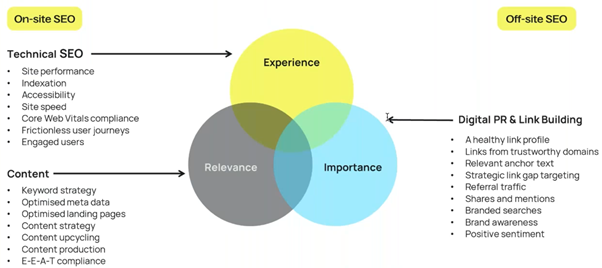
On‑site SEO covers everything that sits on your website from how it’s built to how it’s “decorated.” That breaks down into two key areas: technical SEO and content.
Technical SEO is the foundation. It’s about performance: does your site load quickly? Is it accessible to everyone? Can Google actually crawl and understand your pages? There’s a huge amount written about technical SEO, but at its core, it’s binary, it’s either in good shape or it’s not.
Then you have content, which is where your brand should really shine. You need to understand what your audience is searching for and optimise your pages around those terms. But it’s not just about keywords. It’s about demonstrating expertise, credibility, and trustworthiness. The principles captured in Google’s E‑E‑A‑T guidelines (Experience, Expertise, Authoritativeness, Trust). Great content isn’t just a page that is optimised; it’s valuable and solves problems or educates and inspires people.
Finally, there’s off‑site SEO. Essentially, how you’re earning attention and authority from other websites. This is the area that’s historically been crowded with black‑hat tricks: link buying, link swaps, shortcut schemes that promise quick wins. But just like chasing algorithms, shortcuts rarely pay off, and they often backfire.
The sustainable approach, the one that consistently builds a strong link profile is Digital PR. Creating stories, campaigns, and content that people genuinely want to talk about and link to. It’s harder, but it’s what works.
Two ways AI SEO isn’t like “traditional” SEO
So now that we’ve covered the basics of good SEO, let’s look at how it ties into the AI landscape, because this is where things really start to shift.
A traditional SEO approach typically looks something like this:
You begin by researching the keywords you want to target. You examine search volumes, seasonality, and the intent behind those terms. Then you move into on site optimisation: making sure your website is technically sound and that your content is strong, relevant, and enriched with the keywords you want to rank for.
Once that foundation is set, you focus on Digital PR to strengthen your backlink profile and build authority. Then when all the chains are moving, you measure everything, what the keyword rankings are, click through rates, organic traffic, and all the other performance indicators that tell you whether the strategy is working.
But with AI SEO, the landscape changes dramatically in a few key ways.
Keyword research, as we’ve always known it, is essentially gone. There just isn’t enough reliable analytics around AI-generated search behaviour yet, and we don’t know when or even if traditional keyword metrics will emerge for this space.
Measurement is also incredibly limited. Yes, you can track referrals in GA4 and pick up anecdotal feedback or mentions through word-of-mouth, but it’s still early days. The data simply isn’t mature enough to give you the level of reporting you’re used to in traditional SEO.
And this is something you really need to factor in if you’re going to your leadership team and asking for budget for AI focused search activity. The impact is real, but the measurability isn’t there yet, so expectations need to be set accordingly.
So… what does all this actually mean?
It means that AI SEO is here — but at its core, it’s mainly still SEO.
The same best practice principles that have driven success for years are the ones driving visibility in AI powered search today. As an agency that’s won awards for our SEO work, we’re telling our clients that good AI SEO is simply good traditional SEO done well, but with a few tweaks.
And that’s great news if your business has already invested in SEO over the past few years. If you’ve been building authority, strengthening your content, improving your technical setup, and earning high quality links, you’re already benefiting from that foundation. You’re reaping what you’ve sown.
But if you’re only now starting to think about how to appear in this emerging world of AI agents, if you want your brand to show up in recommendations, summaries, answers, and conversations then you need to start building your full SEO profile from the ground up and it makes sense to do these two channels in tandem, they work best together.
If you want to level up your AI Answer Engine strategy and master optimising your content for discovery in AI-powered platforms, sign up for CIM's AEM training course now. You'll learn how answer engines operate, the types of content they prioritise and how to build semantic relevance and authority.

Related content
Explore related content and courses for further insight


